

☕️ A $40 trillion opportunity (and most investors are missing it)
Apr 22, 2026Howdy! 👋
Imagine that…
Good news is actually good news… stocks are rising after a cease-fire extension and strong earnings.
The S&P 500 is now tracking 7,120 while the Nasdaq is trading at roughly 24,489, which means the former is up roughly 9.5% off recent lows and the latter is up roughly 17.8% off recent lows. Many of the names we talk about regularly have done even better.
I have no idea if that’ll continue, but that’s moot.
I’ve told you time and again “you cannot hope to be up if you’re not investing when the chips are down” – and, frankly, I hope you did.
There’s now a huge pile of money on the sidelines held by investors who thought they were being smart, but who are now coming to terms with the fact that they’re getting left behind again. 🙄
Remember…
Investing isn’t rocket science despite the fact that many people want to make it that way. The path to profits is to a) buy the best, ignore the rest® and b) buy when others can’t resist selling and sell when others can’t resist buying.
Here’s my playbook.
1 – A $40 trillion opportunity (and most investors are missing it)
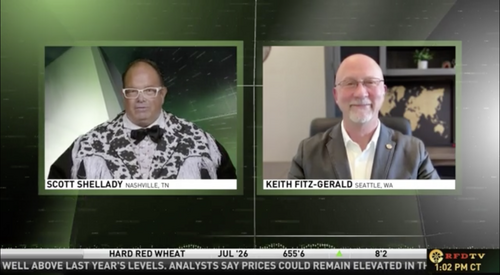
I sat down for a wonderful conversation with my good friend and colleague, Scott "the Cow Guy" Shellady — so named because of the colorful old school pit jackets he wears on air.
We spoke about what I believe to be a $40 trillion opportunity in robotics, why space could be bigger (and sooner) than anyone expects, and how companies like Tesla and Palantir fit into the much larger shift already underway. (Watch)
Hopefully, you've got your slice of the pie already — because somebody else most certainly does if you don't!
Robotics isn't a someday story like Wall Street seems to think or wants you to believe (so they can snap up the bargains before you realize what’s happening).
The convergence of AI, cheap sensors, and next-generation manufacturing is compressing what used to be decade-long adoption curves into years… months even. Something we’ve talked about many, many times.
Investors buying the companies building the picks and shovels for this shift — and the ones deploying the machines — stand to capture returns that many people don’t yet understand and haven't even remotely begun to price in.
For example, Tesla and Palantir get the headlines, but the real opportunity runs deeper than two ticker symbols.
Those folks who come out ahead will be the ones who understand the full supply chain — hardware, software, data infrastructure — not just the names they see on TV. And who invest accordingly.
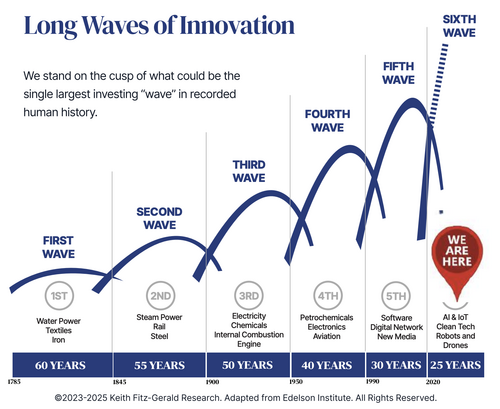
What I call the “6th Wave” — an opportunity unprecedented in human history.
If you haven't sized up your exposure and the bargains at hand, now's a good time to ask yourself why not.
Keith's Investing Tip: History is very clear. The biggest fortunes tend to be made by investors who recognize tidal shifts early and who get their money there first.
2 – First the PIIGS, now the BIFS
Very few people today recall the PIIGS – which yes, was pronounced the way it looks – back in 2011 during the European sovereign debt crisis.
That not so nice acronym stood for Portugal, Ireland, Italy, Greece and Spain which were the so-called problem children of their time because their shoddy banking practices threatened to take down global markets.
I said during an appearance on Varney & Co that it would be a trillion-dollar problem long before most picked up on it and you know how that played out.
Now there are the BIFs (Britain, Italy and France) where credit spreads look to be setting up a repeat. (Read)
I hope not but I’d be remiss not to point out what’s happening.
Bond investors are exacting a heavy price from three of Europe’s largest economies – all of which are struggling with a credibility crisis as the Iran conflict thrusts government borrowing back into the spotlight.
The reason this matters is that when investors – meaning bond buyers – lend to ‘em, they are increasingly concerned about a) where their money is being spent and b) whether they’ll get it back via repayments. I’d add the US to that list, but that’s just me and a topic for another time.
Anyhoooo… you can see that in what’s called the “spreads” – meaning the gap between what Germany pays to borrow and what riskier countries like Britain, Italy, and France – the BIFs - must pay to borrow.
Many investors think so what… this won’t impact me.
That’s a mistake.
We’re all likely to experience higher volatility, tighter credit, and renewed pressure on stocks if sovereign debt fears continue to build.
That’s why I suggest investing in cash-generating, dividend-paying companies with strong balance sheets and pricing power. Oh, and a positive TSY (True Shareholder Yield).
Which brings up an interesting point.
Most investors are still fighting the last war — meaning that they’re chasing the highest yields they can find and wondering why their "income" portfolio keeps disappointing them.
TSY flips that script entirely. It's not about what a company pays you today — it's about what it's worth paying you tomorrow.
That's the difference between income and growing income, and it's why the math almost always favors TSY over yield alone.
For example, Chevron’s listed yield shows up on most public financial sites as 3.83%, but the company’s TSY is nearly 4.94%. And people want to know why I prefer it over the other energy majors… now you know.
Keith’s Investing Tip: My research shows that companies with positive TSY outperform those simply offering yield (which is what most investors chase) – which is why you want to own ‘em, especially if you’re a dividend investor.
Btw, the OBA Family knows all about TSY and has for years which is why they’re enjoying the benefits associated with owning ‘em, but hey, if you’re still good with chasing high yielders only to have ‘em cut their dividends at the worst possible moment, I can’t do a whole lot about that. 🤷🏻
3 – Apple just telegraphed its next move – don’t miss it
I’ve long maintained that there's a good argument to be made that Apple’s actually already won the AI wars… something Wall Street analysts cannot imagine. Neither can legions of analysts who have swallowed the “bait” hook, line and sinker.
And the fact that Apple just promoted Johny Srouji – the company's silicon lead – to the new role of chief hardware officer – at the same time John Ternus was named as the next CEO, lend credence to that argument. (Read)
Here’s what everybody’s missing imho.
While OpenAI, Google, Microsoft, and the rest of the AI crowd have been spending trillions of dollars building ever-bigger cloud models, Apple's been quietly doing something completely different — pushing AI down to the device level, where your data never leaves your hands.
The big models can't do this yet because the chips aren't powerful enough. Apple's been building toward exactly that for years with its custom silicon — M-series, A-series, the Neural Engine — and elevating Srouji tells you where the company's center of gravity is headed.
MyPOV: Apple is going to release something within a year or two that catches the rest of the AI trade completely flat-footed. Not because they out-spent everyone — because while everyone else was building bigger data centers, Apple was building something nobody else can easily copy: a billion-device edge computing network already in people's pockets.
On-device AI solves the two things consumers actually care about — privacy and speed. No cloud round-trip, no data exposure.
Imagine what happens when Apple flips that switch across 2+ billion active devices… the entire installed base and billions of consumers becomes the moat overnight.
AAPL isn't the flashiest AI story right now, which is precisely why it's worth paying attention.
If you've been underweight Apple waiting for a clear catalyst or have fallen prey to the blizzard of c---p that passes for actual investment research, do yourself a favor.
A new CEO and a silicon chief elevation in the same breath is worth taking seriously. Especially since almost nobody else sees this coming.
Keith's Investing Tip: My experience over the past 40 years is that by the time everyone agrees it was obvious, the opportunity's already gone. Just sayin… again, invest early.
4 – Palantir, from the battlefield to the breadbasket
Palantir just struck a $300 million contract with the U.S. Department of Agriculture to manage farmland security as geopolitical risks — the Iran conflict, the trade war with China, disrupted shipping lanes — threaten global food supply chains. (Read)
Apparently, the new program broke records for online signups within 62 minutes of opening.
Sadly, the vast majority of investors and traders will file this under "another government contract" and move on. Or they’ll fall prey to more baloney from the short-crew about how Palantir isn’t a real business.
Big mistake either way.
Ask yourself why China has been quietly buying U.S. farmland for years.
That nagging feeling in the back of your brain isn’t random.
Washington is spooked.
And the USDA just handed Palantir the keys to fix it — using the same AI-powered data infrastructure it already runs for the U.S. military, including the Maven Smart System platform used in Iran.
The way I see it – and here’s the opportunity – Palantir being trusted with the food supply of one of the single most powerful nations on earth because the stuff we put in our mouth isn’t optional.
I've been bullish on PLTR since it was trading in single digits — long before Wall Street could even spell it. "Pala-what?" I got more than once. And yet here we are.
I think there’s a long way to go yet.
Keith’s Investing Tip: The key to owning great stocks (like Palantir) is not getting scared out of ‘em. Karpus Maximumus.
Btw, history suggests there are 10-15 “Palantirs” out there at the moment which is why it’s your job as an investor to find ‘em. The OBA Family already has a few on deck, in case you’re wondering and would like to join in on the hunt. You know where to find me if that’s of interest.
5 – What to do when you don't know what to do
I hear it all the time, especially lately.
"Keith, I'm worried." "I don't know what to do." "Is it safe to stay invested?" “How do I get started?” “Is real estate safe?” “Which companies should I buy?” “What ETFs are best?”
You're not alone in asking if you’re one of those who’s wondering — not by a long shot.
That’s why my dear friend and personal finance expert, the incomparable Suze Orman, is holding a free webinar on Thursday, April 23 2026 at 6pm EST / 3PM PST.
To answer those questions and more.
I want you to listen.
Suze has spent four decades helping smart people build and protect their financial future while avoiding costly mistakes that can set ‘em back forever.
You don’t need to be rich to get it right, says Suze.
But you absolutely DO need to be prepared.
I agree.
My bride and I will be listening and hope you will be too. 😊
Bottom Line
Investing is a journey.
First, you learn how to lose.
Second, you learn how to learn.
Third, you make money using what you've learned by losing.
As always, MAKE it a great day.
You got this – I promise!
Keith 😀


