

☕️ Nvidia: Jensen’s out, what’s it worth now?
Nov 12, 2026Howdy! 👋
I've been doing this a very long time, and I thought I'd seen it all.
Evidently not.
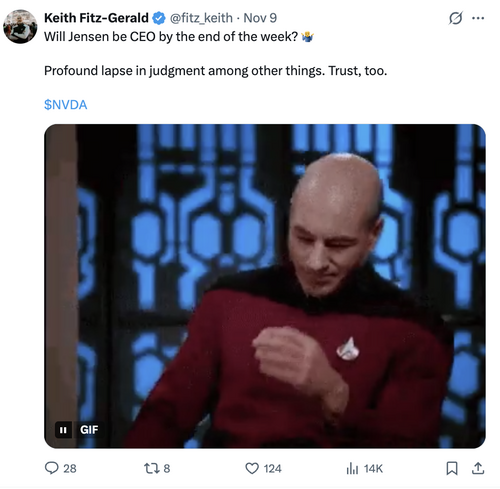
This past Sunday, I asked rhetorically on X whether Jensen would survive the week.
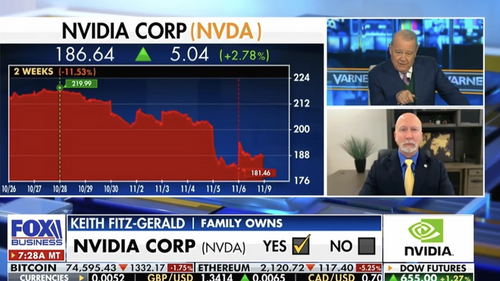
On Monday, during a television appearance ahead of the opening bell, I said I wouldn't encourage investors to buy because I thought the situation could deteriorate.
Now it apparently has.
Not only was there one affair, but reports are swirling about another.
This morning, Jensen resigned, effective immediately.
What's next?
That's the trillion-dollar question.
Three, actually.
- What's Nvidia really worth without him?
- Can Nvidia recover?
- How should you think about the AI trade?
Here's my thinking.
1 – What's Nvidia really worth without him?
If by some miracle Jensen had survived this crisis and stayed at the helm, I was prepared to tell you Nvidia was worth something in the low $300s.
That's moot now.
My answer today is the low to mid $200s, provided a new CEO gains traction.
Here’s why.
From this point forward, investing in Nvidia is a bet on the company itself.
For perspective, Bernstein slashed its Nvidia price target from $400 to $200 while the board was weighing his exit, and the shares fell more than 10% after this morning's announcement.
Keith's Investing Tip: When a founder leaves, the price you pay has to reflect the company that's left behind.
2 – Can Nvidia recover?
This situation reminds me of Apple in 1985, when the board pushed Steve Jobs out of the company he co-founded.
Minus the affairs, of course.
Apple kept its products, its customers and its brand. What it lost was the vision, and it took twelve years, a near-death experience and Jobs' return in 1997 to get it back.
Nvidia, for better or worse, starts from a far stronger position.
The company has roughly $500 billion in bookings for its Blackwell and Rubin chips through the end of 2026, a figure disclosed by Colette Kress, the very executive now running the company on an interim basis. Customers paid $15.6 billion up front in the first half of fiscal 2027, more than double the year before.
Now for the hard part.
The first problem is vision.
Jensen was Nvidia's chief strategist, chief salesman and chief evangelist, all rolled into one leather jacket. Nobody inside the company has been groomed to fill that role, which is precisely why the board is under fire. Rightly so imho.
The second problem is shattered trust.
What's happening calls into question every last decision or comment he's ever made about dang near anything and everything. Every product roadmap. Every demand forecast. Every assurance he gave Washington about China. Every motivational interview about running a company and managerial excellence.
Confidence will have to be rebuilt one quarter at a time… by Jensen's successor.
Impossible, you say?
Believe it or not, history offers some encouragement.
Plenty of companies have come back stronger after a new CEO took the wheel, including several where the old one left under a cloud.
- McDonald's (2019): The board fired CEO Steve Easterbrook over a relationship with an employee. Chris Kempczinski took over, and the stock went on to new highs.
- Uber (2017): Founder Travis Kalanick was forced out amid a culture scandal. Dara Khosrowshahi rebuilt trust, and Uber posted its first full-year operating profit in 2023.
- Chipotle (2018): Brian Niccol replaced founder Steve Ells after a string of food-safety scares wrecked public trust. Shares rose roughly tenfold on his watch.
- Microsoft (2014): Satya Nadella replaced Steve Ballmer. Market value went from about $300 billion to more than $3 trillion.
- AMD (2014): Lisa Su took over a struggling chipmaker trading near $3 a share and built it into one of Nvidia's fiercest rivals.
- IBM (1993): Lou Gerstner replaced John Akers with the company bleeding billions and Wall Street talking breakup. He kept it whole and turned it around.
- Disney (2005): Bob Iger replaced Michael Eisner after a bitter boardroom fight, then bought Pixar, Marvel and Lucasfilm.
The common thread is the one most people don't see yet.
Each board found the right successor... then gave that person room to run. Nvidia's board has yet to do either, but I think odds are very good that they will.
Next week’s earnings call is probably gonna be one of the spiciest I can recall in a long time.
Keith's Investing Tip: Every forward-looking statement is gonna have to be earned all over again so forget about the numbers and think about the bigger picture.
Btw, and if you’re an OBAer, I’ll have some more specific thoughts later today.
3 – How should serious investors think about the AI trade?
Before we get to the money, a word about the man.
This is a terribly unfortunate situation. Jensen will have to live with the consequences of his actions for the rest of his life. So will his family, who almost certainly didn't sign up for this mess.
I truly hope they can find peace somewhere in all this. The human spirit, for all its failings, is resilient. Fortunately, so is our capacity to forgive.
Now, the AI trade.
The AI build-out marches on and I don’t see that changing for the foreseeable future.
In fact, Microsoft, Alphabet, Amazon and Meta are on track to spend $700 billion to $725 billion on capital expenditures this year, up about 75% from $410 billion in 2025. Wall Street expects that figure to top $1 trillion in 2027.
Data centers are still going up, and the folks building them say demand still outruns supply. Microsoft's Azure cloud business grew 48% last quarter. Amazon says it will stay short of capacity into 2027, and Alphabet has signaled a significant capex increase next year.
Power deals are still getting signed. Power supplied to US data centers has nearly tripled since 2020, reaching 64.4 gigawatts in 2025, and is projected to hit 183 gigawatts by 2030. Entergy alone plans $12.9 billion in new gas generation to power Meta's Hyperion campus in Louisiana.
None of that changed when Jensen walked out the door this morning.
The balance of power, on the other hand, has very definitely just shifted.
For years, Nvidia's customers have quietly hunted for a second source so they wouldn't be held hostage to one supplier. Today's news hands every one of 'em a board-approved reason to speed that search up.
Toss in the national security questions now hanging over Nvidia's China dealings, and Washington has every reason to encourage it too.
That's a shot in the arm for every other AI chip maker, imho.
- AMD (AMD): Already upgraded this morning on the argument that it benefits from Nvidia's leadership vacuum.
- Broadcom (AVGO) and Marvell (MRVL): The custom silicon partners hyperscalers turn to when they design their own chips.
- The hyperscalers: Google's TPUs, Amazon's Trainium and Microsoft's Maia all get a fresh look from the purchasing department.
- TSMC (TSM): Manufactures most of these chips regardless of whose name is on the box.
Hmmm.🤔
Seems to me that the demand for compute is every bit as strong today as it was on Monday. The only open question investors need to sort out is how the spoils get divided and to invest accordingly.
Keith's Investing Tip: Follow the concrete, the copper and the kilowatts. Not all tech is the same, especially big tech.
Bottom Line
Drivers change, bet on the engine.

As always, let’s MAKE it a great day — you got this!
I promise.
Keith 😀


