

☕ Robinhood: Wall Street’s sharks smell blood in the water
May 27, 2026Howdy! 👋
The Dow’s tacked on 300 points while the S&P 500 continues to flirt with record highs. The Nasdaq meanwhile has gone “red” as I type, though.
Makes sense.
Here’s why.
The markets are technically over-extended so a sharp quick downturn wouldn’t be outta the question nor would it be unexpected.
Big market moves are funny that way.
People often think they’re all about the numbers but, practically speaking, the numbers are more like a big meal in that the markets need to digest ‘em from time to time.
I think that’s great for one simple reason.
Short term fear always makes long term opportunity cheaper.
Here’s my playbook.
1 – Talking why 6% GDP might be conservative, Iran and Palantir
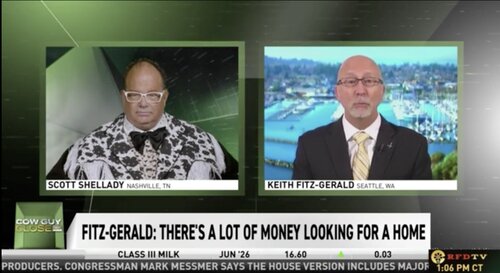
I sat down yesterday for a wide-ranging conversation with my good friend and colleague Scott "the Cow Guy" Shellady. He’s a super sharp former floor trader – so named the Cow Guy for the colorful old-school pit jackets he wears - and it’s always an honor to be on his show.
Scott wanted my take on three things: Kevin Hassett's 6% GDP call, whether the Iran and the Hormuz standoff is actually a gift in disguise for investors, and why Palantir keeps getting pushed around despite numbers that would make most CEOs weep with joy. (Watch)
The short version?
Mindblowers one and all.
Spoiler alert… Hassett might actually be the conservative one in the room! 💯
Keith’s Investing Tip: I learned a simple lesson from one of my mentors years ago. Whenever everybody “knows” something about XYZ – like this is great, this stinks etc - it makes sense to look at the other side of the trade.
2 – 3 new members of the trillion-dollar club
Not one, not two but three. (Read)
SK Hynix joined Samsung and Micron, which joined yesterday, in the $1 trillion market cap club this morning — making it the first time in history that all three dominant global memory chipmakers have held trillion-dollar valuations at the same time.
The valuation crowd and spreadsheet gang are going bonkers.
Let ‘em.
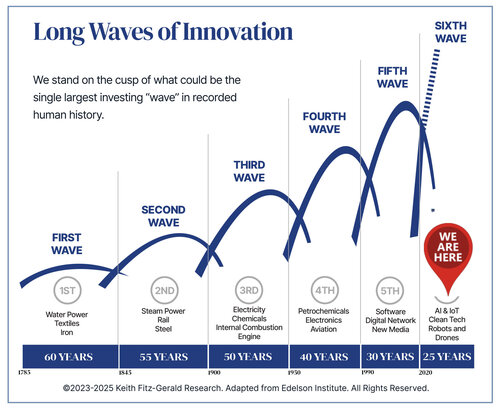
Most analysts are still anchored to early estimates of AI's economic impact because they’re thinking “too small.”
When AI first began scaling, IDC pegged the downstream return at roughly $4.60 for every dollar spent on AI solutions and services — already a compelling case for why the buildout wasn't the speculative bubble skeptics claimed.
My friend and colleague Dan Ives of Wedbush put his own number on it, saying that every dollar spent on an Nvidia chip carries an 8-to-10x multiplier effect cascading through software, enterprise deployment, and productivity gains downstream. But as much as I love Dano, those figures reflect the early innings.
As I've argued on Fox Business and CNBC, we may now be looking at a multiplier of $20 or more for every dollar invested in AI — and the data is starting to catch up to that view.
AI-linked capital expenditure accounted for nearly a fifth of all U.S. GDP growth in Q4 2024. In the first half of 2025, AI-related investment may have driven as much as half of all inflation-adjusted GDP growth in America.
Apply even a conservative multiplier to the $2 trillion in global AI spending projected for 2026, and the downstream economic value generated becomes one of the largest wealth creation events in modern history.
At the risk of sounding like a broken record… if AI were a baseball game, we're STILL so early that the hot dog vendors aren't even warmed up yet.
Keith’s Investing Tip: The question for investors isn't whether the multiplier is real. It's whether they're positioned ahead of it.
3 – Russia just armed its banks against drones
Russia's parliament passed a law this week allowing the central bank, Sberbank, and other financial institutions to operate their own anti-drone defense systems, to have armed security response teams and even jamming equipment.
It’s bank!!!
So what does this mean for investors?
The short answer is something nobody’s yet talking about.
MyPOV is that Wall Street's 'geopolitical risk' models are going to need a bigger spreadsheet when a country's central bank needs its own air defense.
Ukraine's long-range drone campaign has apparently gotten so effective — and Russia's airspace so difficult to defend — that critical financial infrastructure is now considered a legitimate target.
That’s the real shift here.
Most folks are thinking defense stocks, tech and so on but what this tells me is that Mother Russia isn't just worried about military sites anymore but the very nerve center of its economy.
Drones have become a defining feature.
So much so that the global drone market is projected to reach $57.8 billion by 2033 and over $182 billion by 2036. Both numbers are conservative imho, btw.
I hope you’ve got at least a little exposure to the best in class like the OBA Family does.
4 & 5 – Robinhood wants AI in your brokerage account — Wall Street’s sharks smell blood in the water
This is a huge deal on several levels.
Robinhood announced this morning that its customers can now connect third-party AI agents to their accounts — and let them – it, the AI – trade stocks, rebalance portfolios, and even make credit card purchases automatically. All with minimal human involvement required.
CEO Vlad Tenev calls it "democratizing finance for all."
My take?
This is a recipe for disaster and automating stupid decisions at scale. 🤦
I have nothing against Tenev, nor do I hold anything against legions of Robinhood customers, many of whom are really smart folks.
The challenge is that Robinhood's customer base skews young, inexperienced, and — let's be honest — occasionally prone to the kind of trading that makes financial advisors wince and sharp, well-capitalized Wall Street traders absolutely drool. And now those same traders – Wall Street’s go fast crew - know exactly what's coming into the market, when, and roughly why because the AI agents driving those decisions are anything but unpredictable.
The guardrails Robinhood is touting — separate accounts, notifications, a shiny little disconnect button — are fine conceptually. The problem is that they do nothing to protect investors from the two things that actually get people killed financially: judgment and the smarts to pay attention when it counts.
There's an entire generation of investors today who are too young to remember when spreadsheets were supposed to make us better investors. Then personal computers. Then the internet. Then smartphones. Then neural nets. Then trading apps. Each one was going to level the playing field, put the little guy on equal footing with Wall Street, and usher in a golden age of the informed retail investor.
And yet…
DALBAR data — which tracks actual investor behavior and returns — consistently shows that investors are using more information to make worse decisions and far more costly mistakes than ever before.
Now Robinhood wants you to hand your money to an AI agent and hope for the best?
Remember how the game is played (and, news flash, it isn’t pretty).
Wall Street isn't hoping for anything.
They’re sharks who smell blood in the water.
Wall Street’s best traders have armies of quants, petabytes of data, and decades of experience front-running exactly this kind of predictable, patterned, emotionless order flow.
This has a very significant probability of ending badly.
Retail AI agents – and any investor using ‘em - are going to be the most readable, most exploitable counterparties they've ever seen.
And here's the part nobody's talking about in polite conversations.
Robinhood isn’t doing this because they want to democratize investing, although that makes for a polite, PR friendly story. Team Tenev is paid nearly $1 billion a year to rout their customers’ trades to market makers like Citadel Securities and Virtu Financial — firms that collectively handle more than 80% of all U.S. retail equity orders.
That arrangement already exists today, but right now it's humans making impulsive, emotional, and largely random decisions. Throw AI agents into the mix and suddenly those same market makers have something infinitely more valuable than a firehose of retail orders — they have patterns.
Predictable, repeatable, machine-generated patterns that a sophisticated trading desk can read like a menu at an all you can eat buffet. Investors who use Robinhood’s AI are going to think it’s working for them but, in reality, those using it may as well hand over the keys to the castle to the people on the other side of every single trade you make.
This isn't a fintech story and it has nothing to do with democratizing investing.
It's a behavioral finance story dressed up in a press release.
The single biggest drag on investor returns has never been the market or the technology— it's been the investor. Wrapping that problem in a slick AI interface and calling it democratization doesn't solve anything. It turbocharges it.
MyPOV?
Use AI to research, screen, and sharpen your thinking — absolutely. That's a genuine force multiplier. But the moment you hand an algorithm the keys to your account and tell it to go for it unsupervised, you've stopped investing. You've started gambling with extra steps — and the house just got a very clear view of your cards.
I’ll let myself out now… 🤦️
Keith's Investing Tip: They call it the Law of Unintended Consequences for a reason. And here’s the thing… on Wall Street, those consequences are always paid by the same people — the ones who least expect it.
Bottom Line
Investing in optimism beats cowering in pessimism.
Only YOU can make the call that matters.
So make good ones.
Now and as always, let's MAKE it a great day – you got this!
Keith 😀


