

☕ When will Nvidia hit $6 trillion is interesting, but $7 trillion is the real prize
Oct 05, 2026Howdy! 👋
Markets were split to flat in the early going but have turned green just now as I type.
Not that this is a surprise.
Or at least I hope it isn’t… Friday's soft jobs report took a Fed rate hike off the table (sorta), and stocks rallied. Today, traders are simply catching their breath and repricing risk – meaning positioning for better profit potential - as I type.
I encourage you to do the same thing.
Earnings season is about to kick off in earnest again.
Music to my ears because it means we can focus on real results and numbers rather than the markets lurching from headline to headline. 🎉
Remember…
Investing is about focus, not noise.
- Plan.
- Execute.
- Repeat.
Here’s my playbook.
1 – Why this is going to be a transformative earnings season
I sat down with the venerable Stuart Varney this morning and he asked me why I think this could be the “most transformative earnings season ever”. (Watch)
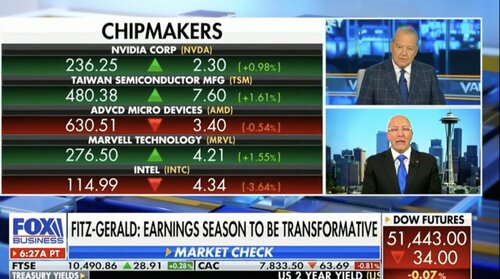
We also spent a minute on Nvidia and three companies that I’m watching closely this week. One, in particular, is a name I’ve owned in the past and am thinking I’d like to take a closer look at again.
Hmmm. 🤔
Keith’s Investing Tip: Make no bones about it, the next generation of millionaires is being printed right now. My job is to help make sure you’re among ‘em!
2 – When will Nvidia hit $6 trillion milestone?

The irony is killing me.
Now the question is “when” not “if” which stands in stark contrast to the poo-hooers – one of whom gleefully (and very nastily) told me on national TV in no uncertain terms that it would “never” hit $1,000 and split (back when it was around $500 or $50 in split adjusted terms if memory serves).
In my best satirical superspy movie voice…. Groovy!
The options markets say:
- ~13% probability that it hits a $6T capitalization this week
- ~50% by the end of the month
- ~70% by December 18, 2026
The more interesting question, though, is when it hits $7 trillion. At least from an investing perspective and at least to me anyway.
You see, $6 trillion requires a price of $248 - $250… roughly 6.5% higher from here.
But $7 trillion?
That implies $290 a share, just 24% higher from here.
Totally doable.
I believe we will get there by the end of the decade but likely a whole lot sooner.
MyPOV: Most investors could probably double the amount of shares they own and still not have enough, particularly those who are “indexing” and who now realize they’re falling behind.
Buy the best, ignore the rest!®
You know what to do and if for some reason I am not being clear enough and you’d like some help, I’ll be here.
3 – This is going to end badly for most, but COULD end up being GREAT for you
A Betterment survey found that about two thirds of Gen Z investors (born roughly between 1997 and 2007) bet on sports. (Read)
Half say they've moved money meant for investing into bets. And about 25% call betting part of their long-term financial plan.
Perhaps I’m just old school but this is going to end badly.
Gambling is not investing and never will be.
Here's the difference, and it's a big one.
- When you buy a great company, you own a piece of something that grows with the economy over time. Dividends boost that return over time.
- When you place a bet, somebody wins, somebody loses but the house takes a cut either way.
"So what," a lot of younger investors say.
I understand… the allure of easy money springs eternal.
Here's a data point to think about.
Last year Americans bet nearly $167 billion on sports. The sportsbooks kept about $17 billion of it. That's roughly 10 cents of every dollar for a bet that's already stacked against you by the odds makers. (Read)
Contrast with the S&P 500, which has never lost money over any 20-year stretch in more than a century. Not one.
Buy the best, ignore the rest® isn't just something I came up with for the heck of it.
Which brings me to a question I hear from younger investors all the time. How much does it actually take to get to a million bucks?
Assume historical average S&P 500 returns with dividends reinvested, and the answer is about $15,900 a year for 20 years.
$15,900 a year sounds like a mountain when you're 25.
It did to me, too.
Break it down.
That's $1,325 a month. About $306 a week. Roughly $44 a day. Split between two people, it's $663 a month apiece.
Suddenly the mountain looks more like a speed bump.
Here's the part I really want you to marinate on.
Over 20 years you'd put in $318,000. The market kicks in the other $682,000. In other words, for every $1 you put in, the markets put in $2 or, if you like, the best companies in America handle the rest.
And you don't even have to start at $15,900?
That doesn’t change the math.
Begin around $11,200 a year and bump it 5% every year as your paycheck grows, and – voila - you can land roughly in the same spot.
A millionaire.
Whatever you can invest, even if it’s just a $100 at a time can make a ‘uuuuuuge difference!
Keith’s Investing Tip: Time is the one asset you can't buy more of later. Use it while it's cheap.
And btw, if you want some help, yep, I’ll be here and am ready to help you just like I’ve helped millions of investors who have paid attention over the past four+ decades.
4 – Beijing just closed 670 banks. Pass the popcorn.
According to Fitch Ratings, Beijing shut or merged a record 670 lenders in 2025, roughly one in four banks in the country. Almost all of them were small rural outfits. The goal is fewer, bigger, better-funded banks that regulators can actually keep an eye on. (Read)
Why now?
Fitch says they have too many bad loans (loans unlikely to be paid back), too little capital cushion, and sloppy management. Bad loans at rural banks hit 2.8%, nearly double the 1.5% average for the system as a whole.
Remember, this is the same system where savers in Henan found their deposits frozen back in 2022. Beijing doesn't want a repeat.
"China shuts hundreds of banks" sounds like 1933 all over again, and the doomers are already out in force.
Here's what gets lost in translation and what most Western observers miss by a country mile.
China effectively runs two banking systems.
The first faces the world. The Big Four state-owned giants are ICBC, China Construction Bank, Agricultural Bank of China and Bank of China. They're listed in Hong Kong, operate globally, clear trade, finance Belt and Road projects, and do business with every major Western institution you can name. These are the banks the rest of the world actually touches.
The second faces inward. These are village banks, rural credit co-ops and small-town lenders that made loans to the local noodle factory, the local developer and the local party secretary's pet projects. Fitch, to its credit, notes that their operations are largely local and their links to the interbank market are limited. The point I want to make is that when the second local banking system wobbles, it wobbles alone.
Again, it’s the second system getting the haircut.
MyPOV… Beijing is doing what Beijing always does. It spots a problem and lets it sit until action is justified. Then it cleans house from the top down, on its own timetable, without asking anybody's permission.
We've seen this movie already, you just may not know it.
In 1999, Beijing created four "bad banks," Huarong, Cinda, Orient and Great Wall, to swallow the Big Four's mountain of bad loans. Then it scrubbed their balance sheets and took them public. The rural overhaul has been running province by province since 2021. In 2025 it simply hit full speed.
And in China, the big banks don't get a choice. Beijing hands them the bad loans and says "you're welcome." ICBC and Bank of Communications have been absorbing village banks in batches and turning them into branches.
Here at home, the best-run big banks get to pick their deals. In 2023, for example, regulators seized First Republic and JPMorgan won the auction. It bought the bank at a discount, and the FDIC agreed to share the losses.
Two systems + two philosophies = one goal: keep the lights on and depositors calm.
Western investors see "670 banks closed" and assume contagion is coming. A $64 trillion banking system that sheds its weakest, most isolated lenders ends up with a sturdier core.
Yes, China's economy has slowed, with Q2 GDP growth at 4.3%, the weakest since 2022 which is why Beijing would rather take its medicine now, while it still controls the dosage.
MyPOV: If you own Chinese names, stick with national champions that have global reach and state backing. Avoid anything that depends on small regional lenders or local government financing. That corner of the market is exactly what Beijing is shrinking.
Keith's Investing Tip: When Beijing cleans house, pay attention to who gets handed the keys. That always tells you where the money is welcome next.
5 – Russian plague trade idea? 🤷️
I am reading/hearing reports from this weekend about a plague outbreak in Russia stemming from a “broken test-tube.” (Read) 🤦
We will never get the real story, so it doesn’t make any sense whatsoever to speculate.
Trade Idea: Speculative put options on airlines or JETS, a popular airline ETF. And, if you’re really aggressive, put options on most of the big indices IF there’s more news, substantiated or not.
This is one of those situations where the machines will sell first and people will ask questions later if this hits the headlines here. Super unfortunate and super nasty if true.
If you’re an investor, the opposite is true.
- Get your buy list ready and stay focused.
- The markets are the only store on earth where people fear a sale.
Keith’s Investing Tip: Missing opportunity is always more expensive than trying to avoid risks you can’t control.
Bottom Line
Action beats reaction every time but especially over time.
You got this — I promise.
As always, let’s MAKE it a great day and start to the week.
Keith 😀


