

☕️ A rare pure-play on affordability without the “AI bubble” risk
Sep 23, 2026Howdy! 👋
Yields are higher once again and, right on cue, all three indices are down.
SOSDD – same old story, different day.
People are reaching for headlines, but the selling is largely mechanical.
I’m not worried and encourage you not to be either.
We’ve discussed why this happens many times… it’s driven by a combination of leverage, short term trading and market makers who must constantly rebalance to keep things in line.
The business case for owning the world’s best companies – including those we talk about frequently – is getting stronger by the minute. To that end and case in point, I think that earnings may be 20-30% this quarter, which will catch a lot of folks by surprise and even more on the sidelines yet again.
As I noted in yesterday’s 5 with Fitz regarding Meta, our brains simply want an explanation… so the headlines are reaching for one when what’s actually happening is far simpler.
Remember.
Short-term fear always makes long-term opportunity cheaper.
Here’s my playbook.
1 – Could the Fed be done raising rates already?
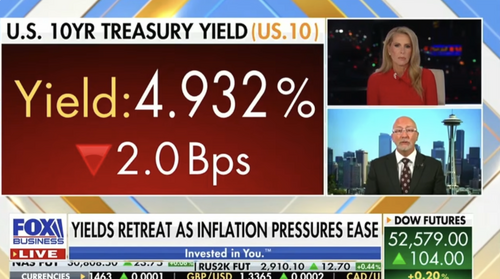
I sat down for a wonderful conversation with the super sharp Cheryl Casone yesterday. We chatted about all sorts of things including Meta, Bitcoin and why I think there’s an outside chance the Fed just might be done raising rates. (Watch)
2 – IonQ hits quantum milestone
Not many people realize it, but quantum computers are notoriously fussy.
Heat, vibration, a little electrical noise… and qubits – the building blocks of a quantum computer – make mistakes. Tiny ones, but over millions of operations in a very short period of time, they add up.
Fixing those mistakes takes a powerful – albeit – regular computer working in the background, spotting and correcting errors in real time.
Trouble is, that regular computers can fall behind. When it does, the quantum machine has to stop and wait. That’s a huge problem and akin to a Formula 1 race car stuck behind a tractor on a one lane bridge.
It’s one of the biggest single challenges of all when it comes to all things quantum.
Yesterday, IonQ said it solved that. (Read)
And in doing so built what it calls the industry's first end-to-end, real-time error decoder.
I picked IonQ as the front-runner early on for several reasons, chief among which included the fact that it had what I believe to be the best, most focused real-world development skills.
That’s still the case.
Kinda puts new meaning into one of my favorite investing maxims, eh.
Buy the best, ignore the rest!®
You probably know this but in case you don’t and it’s helpful… we’ve been talking about quantum computing in One Bar Ahead® from the very beginning and long before the masses caught on. Anybody who’s been following along has had several opportunities to rack up 100%+ winners using the FreeTrade, a tactic I pioneered and first shared with retail investors more than two decades ago, and which is widely copied today.
History, btw, suggests very clearly that there are 10-15 “IonQs” out there right now in various stages of development, so chances are good we’ll be talking about the next 10-15 stocks in short order. In fact, I’ve got a special upgrade planned for our research tech in just this department.
The way I see it, you can “buy the index” and there’s nothing wrong with doing so if that’s your gig OR you can focus moving the needle buy making a deliberate effort to find, buy those things – the needle movers.
It’s always your call but I know what I’ll be doing and what I’d rather see you doing.
3 – ARMs are back… but NOT because anybody loves 'em
I made the observation earlier this month, ARMs are back… but NOT because anybody loves 'em. (See #3)
My exact words: "ARMs aren't free money. They're a bet."
And badda boom.
More people just placed it.
Adjustable-rate mortgages – loans that start with a lower rate but can reset higher down the road – jumped to 9.8% of all mortgage applications last week. That's up from 8.4% the week before. (Read)
Earlier this month, 8.5% raised eyebrows; now we're knocking on nearly 10%.
Why?
Simple.
The average 30-year fixed rate hit 7.12% – the highest since 2024 – while 5-year ARMs are running more than a full percentage point cheaper. Buyers see the smaller number and naturally they grab it.
Keith’s Rule of the Back Page applies.
Most investors will look to traditional lenders, but I think that’s a riskier proposition than many think because we don’t know the risk profile associated with ARM borrowers. I believe that there’s a good case to be made that it’s higher than normal given how many people are still hurting in today’s economy, but that’s just me.
Three ideas come to mind.
- Intercontinental Exchange (ICE) owns the plumbing behind a huge chunk of US mortgages – origination software, servicing platforms and the data lenders use to track loans after they close. ICE gets paid when the loan is written, while it's serviced and, if things go sideways, when it's in default management.
- CME Group (CME) is the other one. Most ARMs reset off SOFR, and more floating-rate debt in the system means more demand for the SOFR futures lenders and investors use to hedge it.
- Manufactured housing gets overlooked by Wall Street for the most part. Both Equity LifeStyle (ELS) and Sun Communities (SUI) serve buyers stretching hardest for a lower payment so they could be worth a think.
Keith’s Investing Tip: Somebody's worry is always somebody else's opportunity, so train yourself to find both sides of the story and profit from the one most miss.
4 – Has China just “lost another submarine?”
US President Donald Trump will sit down with Chinese President Xi Jinping tomorrow in Washington with AI safety reportedly at the very top of their discussion list. (Read)
Good!
I think it's reasonable that there will be some sort of working framework announced, including emergency incident communication and safety definitions themselves. Probably some huffing, puffing and posturing, too.
The real challenge is that neither the US nor China can slow down.
The race is not just about "a tech" but global dominance in all things tech. In that sense, it's like a game of "chicken" in that the first person who blinks loses.
Knowing China like I do, I think there's another angle and, funny enough, it's one that could work to the US's advantage.
It's beginning to dawn on China's ruling elite that AI could threaten their hold on power, whereas the US has assumed that the biggest danger is simply losing the race. (Read)
So China coming to the US… now… strikes me as an implicit acknowledgement that their scientists – ahem – borrowed – AI models that they don't fully understand how to control. They won’t tell that to the world, of course, but my read is that’s the handwriting on the wall. (Read)
What’s happening reminds me of that scene in The Hunt for Red October when the Russian Ambassador has to ask for the US's help finding “another lost submarine.”
If Beijing is worried about AI it can't fully control, Washington goes into these talks with the upper hand on chips, models and the rules of the road. If Washington is worried about AI getting out, then Beijing has everything to gain by ensuring that it does even if it’s not the most advanced, best and so on.
For now, do two things.
- Be sure you own US leaders, the chips and the security layer. Any framework that comes out of this week will likely be written around their technology, which makes them the standard-setters.
- Look past the short-term brinksmanship clearly on display lately and invest very selectively in Chinese AI-related stocks knowing full well that the reasons to own them are contentious, the headlines will get ugly, and that both Washington and Beijing can move the goalposts overnight.
Keith's Investing Tip: In any negotiation, the side asking for help has already told you who holds the cards. History suggests that investing in both the big dog and the underdog is prudent.
5 – A rare pure-play on affordability without the “AI bubble” risk
AutoZone reported yesterday morning. (Read)
Earnings came in at $56.05 a share versus $54.30 expected. That's up 15% from a year ago and a beat. Full-year sales hit a record $20.3 billion.
I’m a self-confessed gear head with a love of all things gasoline, so this hits home.
While everyone's chasing chips, Americans can't afford new cars, so they're keeping the ones they have running.
In that sense, AutoZone is a rare pure-play bet on affordability stress with none of the so-called “AI-bubble” risk.
To be fair, it’s an expensive stock at ~$2,894 as I type, but I can see $3,500 a year from now, a 20.9% upside if I'm correct.
Bottom Line
Every investment has risk, but not all risks are worth the investment.
Choose wisely.
You got this — I promise.
As always, let’s MAKE it a great day.
Keith 😀


