

☕️ Maximum pessimism is never the warning sign; it’s the setup
Sep 10, 2026Howdy! 👋
All three indices are red in the early going.
Excellent!
That means there are some great names being put on “sale” for reasons that have nothing to do with the business case driving ‘em (which, in many cases, is actually super strong which is why I focus on many of the names we talk about frequently).
And volatility means bigger options premiums so you can rake in more money closer to expiration if you’re an option seller (and I hope you are because of the advantage they enjoy over options buyers).
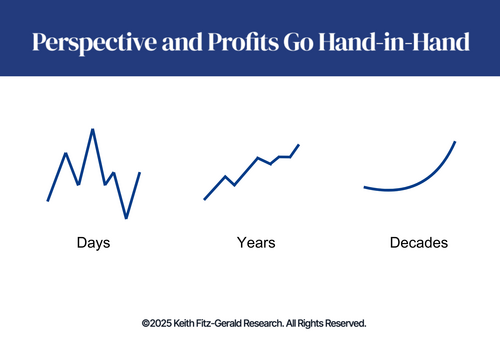
Short-term fear always makes long term profit potential cheaper.
When in doubt, zoom out.
Here’s my playbook.
1 – Maximum pessimism is never the warning sign; it’s the setup
The US10YR just punched through 4.922%, a level not seen since 2023 and up more than 20% since the war in Iran re-started. Predictably, Wall Street’s merry marauders are already selling hard.
The inflation reading being bandied about is a convenient smokescreen, though.
The real takeaway and the one you want to focus on is that Bessent’s bond bomb bombed – you know, the one where the US government would increase bond buybacks and put everything rate-related right. 🙄
I’ve said for years – since the Global Financial Crisis, in fact – that traders would eventually turn their attention to the US when the return of their money became more important than the return on their money.
We’re there.
I think 5% isn’t unimaginable – perhaps as early as tomorrow or next week.
What to do if you’re an investor?
Get rid of anything that made sense at 4%... shorten up your duration to minimize exposure to higher rates via the global bond market… forget about the Fed which has absolutely zero credibility at this point imho. And, while you’re at it, ditch bloated regional banks with fat net interest rate margins because those’ll come under pressure.
Then… invest in optimism.
This isn’t the first time that bond markets have thrown a tantrum and won’t be the last.
Traders have taken Washington to school plenty of times.
- People forget that 1994 was uglier – the Fed hiked rates six times, the 10-Year nearly doubled inside a year, and Orange County literally went bankrupt betting the wrong way if memory serves. The S&P went on to gain better than 30% in 1995 alone.
- 1981 was the real granddaddy of them all – Volcker jacked the 10-Year to 15.84%, the highest print in modern history, and everybody swore the economy was toast. What followed was an 18-year secular bull market that didn't quit until 1999.
- 2013's "taper tantrum" saw the 10-Year nearly double, from 1.66% to 3.04%, in seven months flat on nothing more than Bernanke talking about slowing bond purchases. The S&P still closed out 2013 up over 32%.
- 2022 gave bondholders their worst year in history, full stop – the 10-Year rocketed from 1.5% to over 4.25%. Anybody who panicked out of stocks that year missed the S&P's 24% run in 2023 and another 23% in 2024.
The pattern never changes and that’s what you want to concentrate on.
History is very clear.
People who panic when the bond market panics usually get shaken out right before the best entry points show up.
Maximum pessimism isn't a warning sign as many think.
It's the setup.
Keith’s Investing Tip: At the risk of sounding like a broken record… rates are for traders, profits are for investors. Knowing who you are determines how you approach the markets. And no, you cannot be both despite what a lot of folks like to think.

2 – Macy’s is quietly running the Sears’ playbook
Macy’s beat estimates and raised guidance earlier today. (Read)
CNBC notes that the “turnaround” is beginning to take hold and so on. (Read)
Should you buy it?
Here’s the thing.
So what if it does… turnaround, I mean.
You’re still talking about a retailer that’s going to hit 1% growth, perhaps 1.5% if you’re lucky.
Share prices have underperformed the S&P 500 for a long time. For context, $1,000 invested into Macy’s a decade ago, would be worth ~$939 today – yes you’d have lost money – whereas my two faves would be worth ~$5,337 and ~$7,090 comparatively speaking.
The real risk is one many investors still can’t see coming.
Macy’s appears to be quietly running the Sears’ playbook at a time when other choices in this space have better management, far better profitability, growth and considerably stronger consumer loyalty.
Financial heresy?
Probably.
Macy’s has zero room for error which means that if comps roll over and leverage jumps they could be looking at junk.
Putskies… before dividend risk becomes the story like I think it might.
3 – Apple: I hate to say I told you so but in this case I did, explicitly
Yesterday I said Apple's big event would come down to three questions: a foldable phone, a new Apple Watch, or something AI. (See #4)
We got all three.
- Foldable phone – yes. The iPhone Duo is Apple's first foldable, book-style phone.
- New Apple Watch – yes. Two models this time.
- AI – yes, but not the way the hype machine wanted.
Typical.
Apple is doing what Apple always does: baking everything into the products that 1 in 4 people around the world already own or use.
Siri AI is the centerpiece, still in beta, English-first, with the EU and China waiting their turn. iOS 27 ships September 14 with a more refined Apple Intelligence.
The Watch picks up Audio Intelligence – think live rewind of the last 15 seconds, conversation summaries, smart sound alerts.
AirPods 5 get hands-free Siri AI and Live Translation.
And yes, Apple's capping how much cloud AI you get for free, with iCloud+ subscribers getting more room – a hint of where the real subscription money gets made.
Apple has returned more than 1,000% over the past decade and could easily do a whole lot better in the years ahead if I’m on point. Every $10,000 invested back then would be worth $130,000 or more assuming reinvesting etc.
The SPY, a favorite choice for passive investors, returned 315% which means that same $10,000 invested in it would be worth roughly $41,500.
You can do the math.
Keith’s Investing Tip: Play to win because the cost of missing opportunity is always more expensive than trying to avoid risks you can’t control.
4 – Karpus Maximus and Nvidia just gave doubters another reason to feel stupid
Palantir dropped four announcements this morning, but the one that interests me most is the tie up with Unka Jensen’s Nvidia.
Here's the deal.
Nvidia is running its own supply chain – the one tracking over a million parts per server rack across thousands of suppliers – through Palantir's software, paired with Nvidia’s own Nemotron AI models. (Read)
This is important for two reasons.
First, Palantir’s ontology organizes the mess while Nemotron does the reasoning.
Second, Nvidia is testing this on itself first to prove it works on the hardest supply chain in the industry before rolling it out to customers in manufacturing, energy, healthcare, and aerospace.
Super smart!
I can’t wait to see what happens next.
All of this, mind you, landed the same morning Palantir kicked off AIPCon 11, its customer conference – Cisco, L3Harris, Novartis, and the FAA all took the stage. Oh, and Palantir also rolled out a free cyber-defense program for municipalities and utilities, and deepened its Japan partnership with Fujitsu.
Talk about a “Buy the best, Ignore the Rest®” choice.
Hooyah!
5 – Tokenized stocks: the next recipe for disaster framed as opportunity
Nasdaq is planning to list tokenized stocks in 2027. (Read)
The pitch is 24/7 trading, fractional access and faster settlement… so far so good.
What always gets buried is that retail investors could – and probably will – end up holding the bag because tokenized stocks don’t represent real ownership the way stocks do, and dividend mechanics get muddier than the Okefenokee Swamp.
Think about it.
If the “mechanics” that make the stock market what it is get rewritten, there’s an exceptionally high risk that retail stockholders will be the ones who find out the hard way when they can’t sell, when a dividend doesn’t get received and proxy votes don’t count.
The risks are exceptionally high.
When tokenized shares actually land – and they will – I suggest that you let the institutions and early adopters work out the kinks first. There’s rarely an investable edge in being first through a door that nobody’s tested first.
At the same time, pay VERY careful attention to how market makers react. My experience with eminis, single stock futures, derivatives and so on over the years makes me think that there’s going to be an entirely new 0DTE-style options framework that emerges as the big money learns to manipu… err, hedge… their exposure.
On the good side, volatility will increase which means more opportunity for smart investors.
That part is actually exciting.
Long story short, this is one of those things we can see coming a mile away.
I believe that Wall Street will embrace tokenization the way they did with crypto and after they figure out how to manipulate it in their own interest, usually at the expense of retail investors who are led to believe that what’s happening is innovation.
Keith’s Investing Tip: Whenever Wall Street calls something innovation, check to see who’s holding the bag if it doesn’t work… hint, history says it's rarely them.
Bottom Line
Opportunity is what you make of it, which is why investing in optimism beats cowering in fear.
You got this — I promise.
As always, let’s MAKE it a great day.
Keith 😀


